Introduction
You are chatting with a friend on WhatsApp.
You share an idea. Your friend replies, “I am anti that.” You stop for a moment.
What does anti mean here?
Many people see this word in text messages.
It appears on WhatsApp, Instagram, Snapchat, and other social apps. Sometimes it shows up in comments or quick replies.
This can make people curious. Is it slang?
Is it rude?
Or does it have a special meaning?
That is why many people search for “anti meaning in text.”
The good news is that the meaning is simple.
Once you learn it, you will understand it easily in chats.
Let’s explain it in very easy words.
What Does “Anti” Mean in Text?
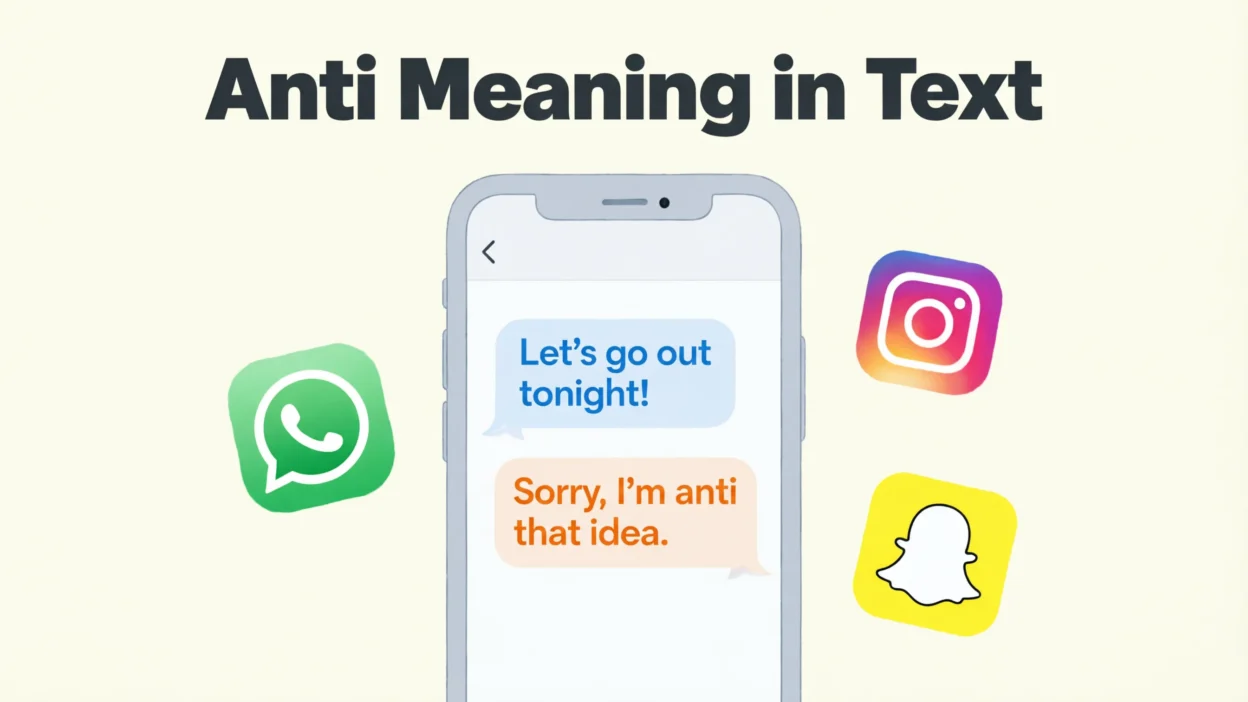
Anti means you are against something.
In simple words, it means you do not support it or you do not like the idea.
Example:
“I am anti that plan.”
This means:
“I do not agree with that plan.”
Full Form of “Anti” (If Any)
Anti does not have a full form.
It is a prefix in English.
It simply means against or opposite of something.
People also use it alone in chats as slang.
How Is “Anti” Used in Chat?
Here are some simple chat examples.
Example 1
Friend: Let’s watch a horror movie tonight.
You: I’m anti horror movies.
Meaning: You do not like horror movies.
Example 2
Friend: We should wake up at 5 AM.
You: I’m anti that idea.
Meaning: You disagree.
Example 3
Friend: I want pineapple on pizza.
You: I’m totally anti pineapple pizza.
Meaning: You strongly dislike it.
What Does “Anti” Mean From a Girl / Boy?
The meaning is usually the same.
It simply shows disagreement or dislike.
But the tone can change a little.
From a girl:
It may sound playful or casual.
Example: “I’m anti spicy food.”
From a boy:
It may sound direct or joking.
Example: “Bro, I’m anti that plan.”
Most of the time, it is just a casual opinion.
Is “Anti” Rude or Polite?
Anti is usually neutral.
It is not automatically rude.
But tone matters.
It can sound rude if used harshly.
Example:
“I’m anti everything you say.”
This may sound unfriendly.
But in normal chats, it is casual and harmless.
When Should You Use “Anti”?
You can use it in casual chats such as:
- Talking with friends
- Social media comments
- Light jokes in messages
- Sharing personal opinions
- Fun debates with friends
When Should You NOT Use “Anti”?
Avoid using it in serious situations like:
- Work emails
- Talking to your boss
- School assignments
- Formal messages
- Respectful talks with elders
In these cases, it is better to say “I disagree” or “I do not support that.”
Best Replies to “Anti”
If someone says “I’m anti that,” you can reply like this:
- “Haha why?”
- “What’s wrong with it?”
- “Okay, what do you suggest then?”
- “Fair enough.”
- “Alright, we can pick something else.”
These replies keep the chat friendly.
“Anti” Meaning on WhatsApp, Instagram, Snapchat
The meaning does not change across platforms.
On WhatsApp, it appears in personal chats.
at Instagram, people use it in comments or captions.
On Snapchat, it appears in quick messages.
In all cases, anti means being against something.
Similar Slang Words Like “Anti”
Here are some related slang expressions.
1. Nope
Means a strong no.
2. Not into it
Means you do not like something.
3. Hard pass
Means you strongly refuse something.
4. Nah
A casual way to say no.
5. Not my thing
Means it is not something you enjoy.
FAQs
Is “anti” positive or negative?
It is usually negative because it shows disagreement.
Is it safe to use with elders?
Not always.
It may sound too casual.
Is “anti” common in daily chat?
Yes.
Many people use it in casual online conversations.
Can “anti” mean hate?
Not exactly.
It usually means disagree or not support, not hate.
Is it slang or a normal word?
It is a normal English word, but people also use it like slang in chats.
Conclusion
Now you know the anti meaning in text. It simply means being against something or not supporting an idea. People use it in casual chats on WhatsApp, Instagram, and Snapchat. It is simple. It is common. And it is easy to understand. Just remember one thing. Use it mainly in friendly conversations. Now when someone writes “I’m anti that,” you will know exactly what they mean